

From 19 to 30 October, LIFE Institute participated in the 17th Conference of the Parties to the Convention on Biological Diversity (COP17), held in Yerevan, Armenia. Throughout the conference, the Institute contributed to international discussions on biodiversity finance, corporate metrics, technological innovation, impact reporting, and mechanisms to scale up investment in conservation.
More than a series of events, COP17 reflected an important shift in the global landscape: biodiversity is increasingly moving beyond the realm of commitments and becoming embedded in corporate strategies, financial markets, and decision-making processes.
From Ambition to Implementation
Four years after the adoption of the Kunming-Montreal Global Biodiversity Framework (KMGBF), discussions at COP17 were focused on implementation.
The priority is no longer simply to define targets for nature protection, but to create the conditions that enable governments, businesses, and financial institutions to demonstrate tangible outcomes.
Across the conference, discussions revealed growing convergence around three essential enablers: credible metrics, effective financing mechanisms, and tools capable of turning data into decisions.
Measuring to Manage
Advancing corporate biodiversity metrics was one of LIFE’s key themes throughout COP17.
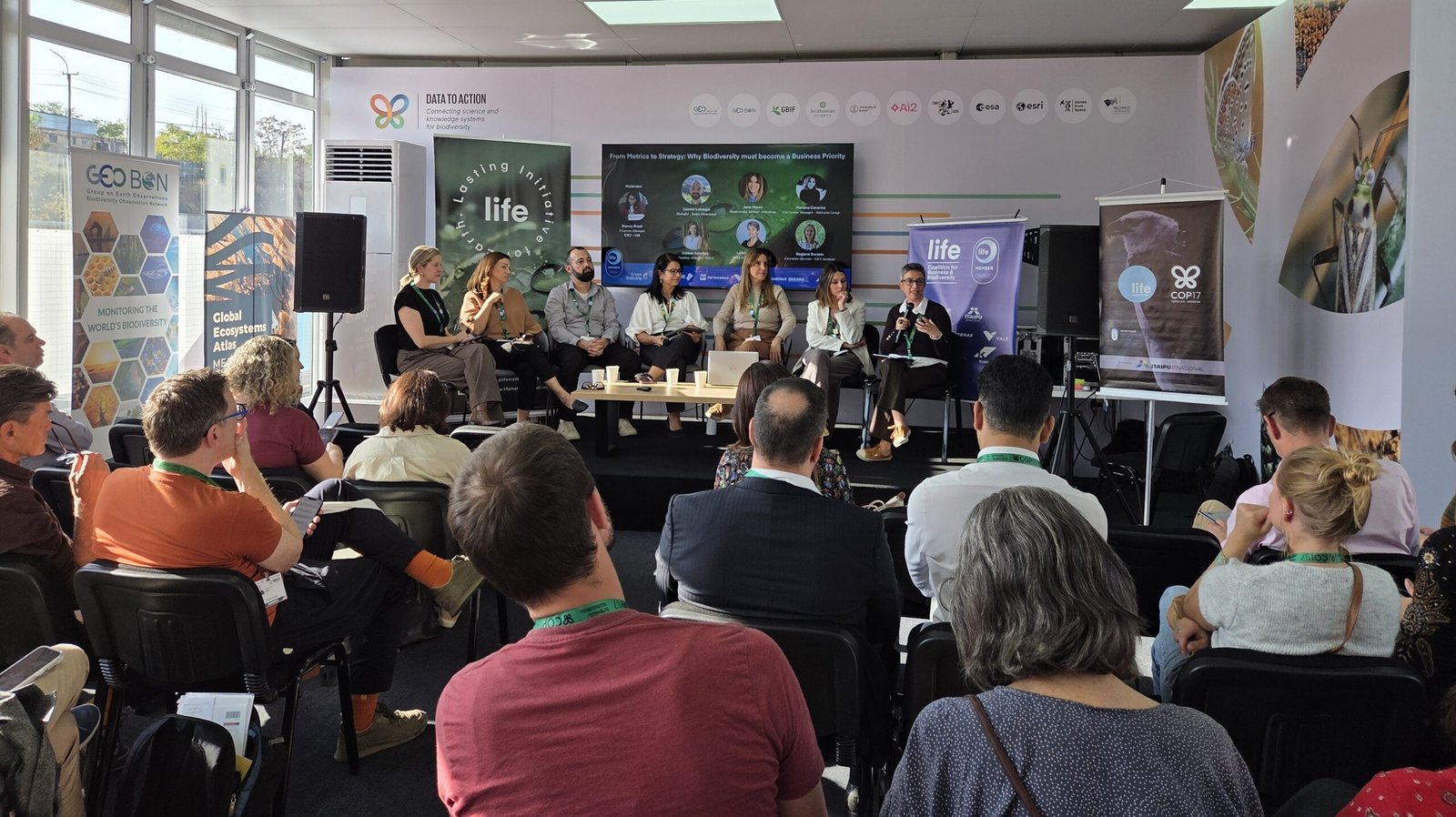
During the panel From Metrics to Strategy: Why Biodiversity Must Become a Business Priority, organized by the LIFE Coalition for Business & Biodiversity, with participation of UNEP-WCMC and the CBD Secretariat, participants explored how biodiversity can be integrated into business strategy through indicators that support decision-making and track performance over time.
This reflects increasing demand from investors, regulators, and markets for more robust information on nature-related dependencies, impacts, risks, and positive contributions. In this context, measurement is evolving from a reporting requirement into a strategic management tool.
The event also marked the launch of the LIFE Coalition’s Statement, a collective declaration by business leaders committed to advancing biodiversity within corporate agendas.
Turning Data into Action Through Technology
Another key focus of LIFE’s COP17 agenda was the role of technology in biodiversity management.
The LIFE Institute hosted the panel Biodiversity Data in Practice: Connecting Monitoring, Management and Reporting with LIFE Key, bringing together practical experiences on how organizations can use data to connect monitoring, management, and reporting processes.
The discussion highlighted one of today’s most pressing challenges for both public and private organizations: transforming fragmented environmental data into actionable intelligence that supports decision-making, guides investment, and demonstrates results.
The conversation continued at the Biodiversity Technology & Innovation Expo, a showcase for technological solutions supporting biodiversity conservation and sustainable use, where LIFE Key was presented as a tool designed to enable evidence-based biodiversity management.
Financing Biodiversity
Throughout COP17, LIFE participated in discussions on biodiversity credits, market integrity, governance, and innovative financing mechanisms alongside international organizations, businesses, and financial institutions.
These discussions reflected an increasingly shared understanding that biodiversity markets and finance mechanisms will only scale successfully if they are built on robust methodologies, continuous monitoring, and clear standards of credibility.
In this context, practical initiatives already in operation are becoming increasingly valuable, helping to shape models capable of mobilizing resources at scale.
The Private Sector Takes Center Stage
COP17 also underscored the increasingly important role of businesses and financial institutions in delivering the goals of the Global Biodiversity Framework.
The participation of LIFE Coalition for Business & Biodiversity members, including Vale and BRDE, in the Business & Biodiversity Forum demonstrated that biodiversity is becoming an increasingly important consideration in both corporate strategy and investment decisions.
The challenge now is to accelerate these efforts, scale successful initiatives, and strengthen the connection between metrics, management, and finance.
A Results-Driven Agenda for Nature
LIFE’s participation at COP17 reinforced a message that echoed throughout the conference: there can be no transition to a nature-positive economy without mechanisms capable of measuring outcomes, directing investment, and building trust.
Metrics, technology, and finance are no longer separate conversations. They have become integral components of a single implementation agenda.
For LIFE Institute, COP17 provided an opportunity to contribute to this global discussion by showcasing practical experience, applied methodologies, and solutions designed to help businesses, financial institutions, and governments build an economy that recognizes, values, and conserves biodiversity.
LIFE Institute’s participation in COP17 was made possible through the sponsorship of Itaipu Binacional. This support helped strengthen Brazil’s presence in international discussions on biodiversity, metrics, finance, and practical solutions for implementing the Global Biodiversity Framework.
LIFE COP17 – Sponsored by